Being a Silk Route cyclist is a busy job: get up early (6AM!), take a shower and into cycling cloths, pack duffel back, bring duffel back and bicycle downstairs (walk twice when no elevator is available), check out (be careful not to pay for polluted towels), riders meeting at 6:30AM, breakfast around 7AM, start the journey soon after, enjoy the ride and make stops when appropriate (temples, views, lunch, photo’s, ice cream and/or ice tea, peaches for sale along the road, say hi to other riders), arrive at the hotel, bring duffel and bicycle to room, shower, get something to drink (usually go to a supermarket of some sort), sometimes laundry or going to the local market and walk around the city, dinner at 6PM, after dinner walk at approx. 7PM, bed time somewhere at 9:30PM. What I want to say, is that there are so many experiences that I’m not up to date when writing my blog… I’m already in Pingliang but still wanna share Shaolin temple (in Dengfeng) and the Terracotta army (in Xian) with you.
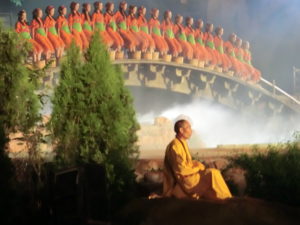
After a tough day, 150 km with climbing at the end, we reached Dengfeng. The village is known for the Shaolin temple. Founded in the 5th century, the temple is associated with the Chinese martial arts, particularly Shaolin Kung Fu. So in the evening we went to see a great outdoor performance about Kung Fu’s life. The décor was awesome, in the mountains, with waterfall, bridge, two ancient houses and light effects high up on the top. The performance was even more spectacular! It started with Kung Fu’s birth, water and a small child on stage. His childhood and how his martial art developed. At a certain point, there were even goats walking around! Light effects were amazing when there were people flying in the air, performing martial arts! Buddhism was introduced with huge horns and Buddhist rituals. I was surprised to see how much influence Buddhism has in China, particularly in this province and I never associated martial arts with Buddhism. Along the route, I see quite frequently a temple with different statues, small and big.
 In the morning we went to the Shaolin temple itself. Communism in China does not exclude capitalism. They go very well together! There were many tourist shops with tourist prices at the entrance (10 Yuan for an ice tea instead of the normal 3 Yuan). The Shaolin area boasts rich cultural and natural attractions such as the thousand year old Shaolin “Zen Buddhism, Martial arts and Medicine” and beautiful natural views (when there are no clouds or smog I assume).
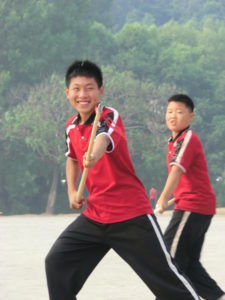 One of the first very impressive things we saw was the start of a school day! The Shaolin Tagou Martial Arts School is located on the Shaolin temple premises, and has more than 30.000 students and staff. “The martial arts teaching include general basic skills (not sure what that is though), kick boxing, boxing, taekwondo, martial arts performing etc. (not sure what the etc. is). The rate of student perusing higher level education or being employed is more than 80% (which is low to me, since I have the impression that everyone is working in China and I can’t believe there is an unemployment rate of 20%)” Anyway, the early morning exercises were impressive:
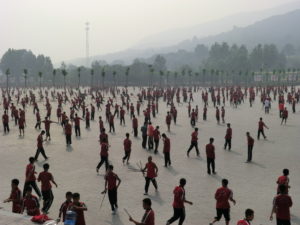
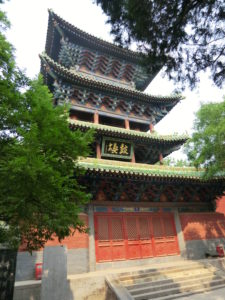
There were many many students, all doing some kind of King Fu exercise. Very impressive! Same as the rest of the complex! There were temples behind temples and the drum tower was certainly one of the most memorable ones. There were very old tables with inscriptions, some of the ‘carried’ by a turtle. Of course there were buddha’s and other statues.
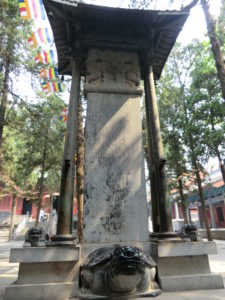
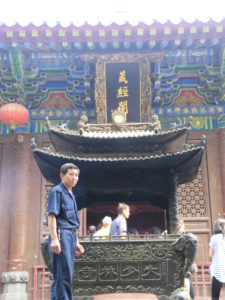
After seen the temple itself, I walked towards the … when I saw a sign for a temple which I thought to be ‘just around the corner’. Wrong… The path led up to a Buddha statue all the way up the mountain, a 250 meter climb! Something I did not expect… The Chuzu temple was somewhere halfway and I assume it doesn’t get many visitors. The climb was steep, and somewhere I met a student briefly. No words were exchanged, but his ascent with hands and head first, made quite an impression! At the summit, I had a silent moment with a monk, watching over the valley. That was cool!
Back in the valley again, I visited the Pagoda forest. During various dynasties some 248 stupas (or small pagoda’s) were made out of stone bricks and build between trees, hence the name Pagoda forest.
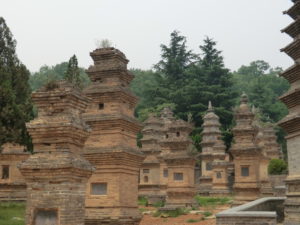
And that was when I noticed time. Almost 1PM, and there was no Silk Route rider around… I hurried back to the hotel, found a note from Paul that they left at 11:30AM and made a phone call that I was leaving as well. He knew I have made other cycle tours by myself, so he knew I would be OK.
Although not necessary, Paul and Ingrid waited at the lunch stop and Paul and I cycled the last part together.
You must be logged in to post a comment.